Friday, April 11, 2014

FA in the Media (And the Return of an Errant Blogger)

Greetings, good people. It's been a long time! Graduate school was a fantastic experience, but as you know, I had to stop teaching FA, for the most part. I just didn't have the mental energy to spare. I'm happy to say that I am once again working with women (and sometimes their partners) to help them manage their fertility naturally. If you are interested in obtaining instruction, either for the first time or to extend your education, my brain is once again available, and I hope you will get in touch!

Graduate school was also not good for this blog. I was happy if I could shave my legs once a month, forget about whipping up a decent blog post. When I finally got my MSW (master of social work) in August of 2013,  I wasn't sure if I'd come back to the blog. Compared to other social media, blogs are pretty old school. All those words! I post on Facebook about 2x a month, and last month, even though I said I never would, I began tweeting (@fertaware) But people do still visit the blog, every day, and every once in a while my writing wants to stretch out a bit, which isn't really possible on Facebook or Twitter. So here we are, blogging again.

And what brings me back to you today? Zeitgeist. A change in the national conversation around contraception. Everyone, it seems, is talking about Fertility Awareness Based Methods (FABM)! Fertility tracking app sales are through the roof. And we are finally getting some decent media exposure.

Let's start with the most recent: Lisa DeBode wrote an unusually well-researched piece about FABM  for Al Jazeera America. (And I got to say "labia" in international media.)
Birth Control Bitter Pill - Al Jazeera

About 6 months prior, a similar article regarding barriers to widespread use of FABM was published in the Atlantic. It contains a couple of inaccuracies, and fewer people are interviewed, but it does present a more sophisticated view than one usually finds. Note how both articles talk about unmet need, i.e. the desire on the part of women to learn these methods and the limitations to their being able to do so.
New Old School Birth Control Atlantic

And finally, a book. Have you read Sweetening the Pill? It came out in 2013, and it definitely set tongues-a-wagging. Now a movie is in the works (I'm in conversation with the producer) and even before the movie has been made, there is backlash & controversy. It's still considered anti-feminist to question the primacy, safety, and desirability of hormonal contraception. If you've ever been unhappy with hormonal contraception, but couldn't articulate why, or if you knew why, but couldn't get anyone to take you seriously, this is for you. Needless to say, it makes a strong case for FA.

It's great to be back, and I look forward to connecting with new readers and old ones, in this context and in others. FA is moving forward, and I'm thrilled to be part of the journey.


Thursday, August 2, 2012

Meals, Snacks, and Obamacare

Hello everyone. I know, I've been a very irregular blogger of late. In the 5 years since I started this blog, a lifetime in internet time, blogging has become old school. It's too long-form. Facebook, Twitter, Tumblr, Pinterest - they're what's happening. The fewer words, the better. The blog still has its readers, of course. But the FB page is where the action is. Do I think this march toward brevity heralds the decline of literacy and civilization itself? Why yes, I do. Am I guilty of it as well? Absolutely. I post on FB far more often than I post here. Usually just a link with a sentence or two. Blogs are meals. And most people are snackers.


Meanwhile, for you gourmands, here's something more substantial:

The Affordable Health Care Act (aka "Obamacare") is slowly coming to fruition, with many benefits already in effect and others not yet realized. It's a very detailed Act and few people go beyond the sound bites to actually learn what's in it. Today, August 1, 2012, a raft of benefits for women and children came into effect. Two organizations have been doing a good job of getting the word out about specific benefits for women. 

-We Are Ultraviolet has created a lovely graphic (below) which hits the highlights. It's too large to read properly in this space, so click on this link to see the whole thing. Or, you can view it (and share it) on Facebook. Sigh.

-And the wonderful folks over at the National Women's Health Network have created a 
site (actually, a blog!) which has been providing detailed coverage with analysis called Countdown to Coverage, with one post per day in the week leading up to today's rollout. Their name for the Affordable Care Act is Mamacare :)

Do the new regulations provide for free Fertility Awareness instruction? No. The Act only provides  free contraception in the case of FDA approved devices. Now, if you're among the fraction of people who receive FA or NFP education in a medical setting, your healthcare provider can code your visit in such a way that it's covered. That's been the case for years. And as more women gain health insurance through the Affordable Care Act, more women will be able to take advantage of that coverage. But the majority of women who practice Fertility Awareness to avoid pregnancy will continue to gain their instruction privately. (Or, frighteningly, practice without benefit of instruction.) 

The Affordable Care Act will thus probably not result in much greater numbers of women practicing Fertility Awareness. But with mandatory coverage and the elimination of co-pays for things like Pap smears, gestational diabetes screening, breastfeeding equipment and lactation support, and screening for domestic violence as well as counseling, the Affordable Care Act reaches far beyond "free birth control," and will result in vast health benefits for women and their children, especially those who currently face financial barriers to service. And that's something we should all be able to get behind.


Tuesday, February 14, 2012

Ten Years in the Making! vagina vérité Now Available

Alexandra Jacoby's book of vulva portraits is FINALLY available for purchase! And now, till 2/27, you can get $10 off. How sweet is that? Use code SAVE10 at checkout. I'm very excited that this book is making its long-awaited and much-anticipated debut. This is an artist's print of the book; self-published. Positive buzz will help land a traditional (well not so traditional) publisher. We need more books like this! We need more conversations like this!

If you can't afford the book, or just want to share the text with someone, you can read it here. (Clicking the link will open a text file - no pics. Trust me, it's safe. Unless you don't like stimulating, heartfelt writing about stuff that normally doesn't get written about.)

Viva la vulva! And congratulations to Alexandra.

Oh, and Happy V-Day everyone.


Saturday, September 3, 2011

Our Daughter's Bedrooms

Yes, as anticipated, graduate school is kicking my butt. I don't know how often I'll be able to post. But when I can, I will draw your attention to stuff I think is worthwhile. Like this new book by Joyce McFadden. It's called Our Daughter's Bedrooms. The book emerged from McFadden's mental health care practice. Following up on trends she was seeing among her patients, she launched the Women's Realities Study, in which she interviewed hundreds of women from 18 to 105. Three major themes (which will not surprise you) emerged from this study: masturbation, menstruation, and relationships with mothers. McFadden found that women's relationships with their mothers profoundly influenced the development of their sexuality: their self-confidence, their feelings about their bodies, and how they deal with challenges around sexuality and fertility throughout their lives. Her book discusses the development of sexuality within the context of the mother/daughter relationship and sets out a model for how we can nurture girls and raise healthy, confident women who are comfortable with themselves as sexual beings.


You can watch a video of McFadden discussing the book on her website (link above). And, if you're in NYC, you can catch her doing periodic speaking engagements. She'll be at Bluestockings on Tuesday, September 13th, at 7PM. Bluestockings is at 172 Allen Street at Stanton (on the Lower East Side). 

Sunday, July 24, 2011

Ilene is on Hiatus!!!

As some of you know, I will be starting a full-time, two year master's degree program in September, in social work. And, just to make things more exciting, I'm also moving (both home and office, because I work at home). Therefore I am going on hiatus. Actually I am already on hiatus, at least as far as teaching is concerned. I have already begun to refer new clients to other teachers. I'm not sure how long the hiatus will last. I'm going to see how things unfold. 


I will continue to be involved in Fertility Awareness, but mostly in ways that won't be obvious to the general public. In addition to teaching, I do a lot of behind the scenes stuff having to do with Fertility Awareness as a profession. Although there are a few paths to professional certification, there are no national or international standards in place regarding qualifications to teach. Anyone can call herself a teacher (or sell fertility-management software). And of course practitioners in the field find little or no support from the medical community, and are often isolated in their own communities because qualified, secular (non-religious) instructors are so few and far between. Thus it can be difficult for them to find peer support and to grow as professionals.


I have been involved in the issue of professionalism in this field since I began teaching 10 years ago. I will be focusing on this work in the coming year, by expanding and strengthening our professional network, and by creating what I hope will be a widely recognized set of standards. I will also continue to coordinate professional forums through which people involved in the field communicate with and learn from each other. So, in the coming months I will be primarily involved in those activities. I will leave the teaching, at least temporarily, to others. 


One of the things I've been focusing my energies on this past year, as I prepared to make this transition, has been the training of new teachers. I've had the privilege of working with several young women who are well on their way to becoming qualified instructors, with a wide range of interests and areas of concentration. They will continue their training with Oregon instructor Sarah Bly, and I look forward to introducing you to them in the future as they embark on their teaching careers.


I have also been working with Sarah on another project which I think at this point is still a secret :) I will tell you all about it once it's ready to go public.


And actually I've been working on another project having to do with Fertility Awareness that is also not quite ready for launch; that's something else I hope to share with you in the near future. 


Ok, so maybe "hiatus" isn't the right word. I guess it's more like "scaling back." 


So, if you are reading this, and you are in need of instruction, what should you do? Here are my suggestions:


--If you want to obtain instruction in a secular context, the Justisse website lists many qualified FA teachers, including graduates and current students of their own teacher training program. Make sure to pay attention to the various designations. I would suggest sticking to FAE's and full (graduated) HRHP's. A lot of teachers can work by phone or by Skype these days, so don't worry if there is no teacher in your area (and there probably isn't).
Justisse directory of instructors


--Not on the list, but worth considering, are:


Katie Singer (author of Garden of Fertility)
New Mexico
(505)820-0773
You will need to have read one of her books if you want to make an appointment with her.

Sarah Bly
Oregon
www.graceofthemoon.com

--Please mention my name if you contact any of these instructors so they know where the referral came from.

--Of course if you're open to studying Natural Family Planning (NFP), as opposed to FAM, you'll have many more instructors available to you, including some from whom you might be able to learn in person (as opposed to long distance). NFP is in many ways the same as FAM, but is taught in a religious/moral context. Sexual activity outside of marriage (and certainly same sex activity) is considered unacceptable, as are all forms of "artificial" contraception and abortion. The main NFP organizations in the US are the Couple to Couple League and the Billings Ovulation Method Association. Their websites can direct you to local teachers. Be aware that NFP teachers often have fairly rudimentary training and may not be able to advise you with respect to complex or health-related issues.

I will miss teaching like crazy, but I am also very excited about all the new developments in my life. I plan to keep updating the blog and the Facebook page, though probably not as often as I do now. As always, I invite you to keep in touch with me. Having a baby? I would love to hear about it! Moving? Send me your new coordinates! My coordinates, by the way, will probably remain the same. The email address will definitely stay the same, and I think the phone number will, too. If not, I'll let you know. 


Enjoy the rest of the summer. 

Sunday, June 26, 2011

Two Good New Books About Your Down There

You've heard this before: there are so few realistic images of women's bodies, and so many images of airbrushed, surgically-altered women, that most women have no idea what normal is, and often think that they are abnormal, unattractive, etc. Although the problem is pervasive when it comes to women's overall appearance, it's even more acute when we consider women's vulvas. Aside from images in pornography, many women have never seen another woman's external genitalia. And just as our breasts don't look like porn star breasts, our genitals don't look like porn star genitals.

A few women (and men) have taken matters into their own hands. I've written many times about Alexandra Jacoby's vulva portraitraiture project. Now there is a new book, out of Canada, which essentially tackles the same idea. By showing each other what we look like, we can come to understand that variety is normal, and beautiful. I'll Show You Mine consists of 120 portraits of 60 women, all in exactly the same 2 poses (frontal and with legs spread), along with text written by the women about their relationships with their vulvas. The women are fairly diverse, ranging in age from 19 to 60, with varied backgrounds and lifestyles. They comprise a range of ethnicities and sizes; there is even a trans woman. The book is beautifully produced, in an environmentally sound manner, and 10% of proceeds go to women's charities. And as with so many media products these days, there is a highly interactive website to accompany it. The book is mainly available in Canada. If you're in the US or elsewhere, you'll probably need to order it by mail from their website. 


I've also been very impressed by a new book that deals in a straightforward, cogent way with a problem that many women have, but few women talk about. The book is called When Sex Hurts: A Woman's Guide to Banishing Sexual Pain. Although there are many causes of genital pain in women, we generally divide them into two broad categories. Vulvodynia means "pain in the vulva" and is considered a chronic pain condition, though the pain may be constant, intermittent, or primarily provoked by touch. Dyspareunia ("dis-pah-roo-nee-ah") refers to painful intercourse. Just as women tend not to discuss their feelings of shame or inadequacy around the appearance of their genitals, they rarely talk about their vulvar pain, even with their doctors, who can be dismissive and/or ignorant. The authors estimate that up to 40% of women with these pain conditions don't seek medical care, and those that do will often end up seeing many different practitioners before obtaining a diagnosis, if they receive one at all. The book is written by 2 doctors and a psychologist, and I found their approach to be smart, frank, understanding, and hopeful. Women with these pain conditions can become very depressed and disempowered. While this book will never hit the best-seller list, I hope that many women who need it will find it.  


Tuesday, May 31, 2011

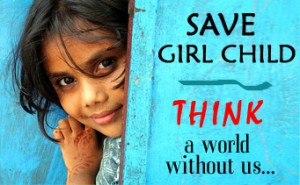
India's Girls Are Being Decimated

Most people who use the word "decimate" do not understand its true meaning or origin. They use it to mean a wiping out, a massive defeat, or a natural disaster. The tornado decimated Joplin, Missouri. In reality, it means the slaughter of 1/10 of a population. Decimation was used as a form of military punishment for cowardice in Roman times, and occasionally thereafter. So there aren't too many instances in which one can correctly use this word. But the appalling truth is that it can accurately be applied to many parts of India, where one in ten female fetuses is now being selectively aborted.

You may be familiar with this phenomenon from China, where the one-child policy, along with a preference for males, has been a major contributing factor to a skewed birth ratio. In a normal human population, slightly more boys are born than girls, with ratios ranging from around 103 to 109 males born for every 100 females. This naturally leads to a roughly 1:1 ratio of adults. But in countries such as China and India, where sex-selective abortion and infanticide occur, this ratio can become extremely skewed. In 2005, the ratio in China was at 119 to 100, and in some parts it had reached the astonishing imbalance of 130 males to 100 females. It is estimated that some 24 million Chinese men will be unable to marry when they reach adulthood around 2020, because their potential brides were selectively aborted.

India has apparently learned nothing from China's example, and although education and income levels have been rising in India, so too has the problem of selective abortion. In fact, according to a new study, it appears that the phenomenon is actually directly linked to affluence and education: educated, well-off women are far more likely to obtain an ultrasound and abort a female fetus. Thus, the latest Indian census found a ratio of 914 girls for every 1000 boys, which is the most imbalanced since India gained independence in 1947. Girls in India are literally being decimated.

The total numbers are staggering: in the last 30 years, it is estimated that between 4 and 12 million Indian females have been selectively aborted. Of course, the practice of using ultrasound to determine the sex of a fetus in order to selectively abort is illegal in India, but until deeply held cultural beliefs are changed, the laws are essentially meaningless. So-called "honor killings" are also illegal in India, yet a 2010 study found that 1000 people per year were being murdered by their family members for bringing "disgrace" to their family.

Here are a couple of recent articles which discuss the phenomenon of sex-selective abortion in India, as well as a link to the original study from which these articles were drawn:
-As Wealth and Literacy Rise in India, Report Says, So Do Sex-Selective Abortions  
-Earlier article on same topic, also from NY Times, with more social context
-Original study published in The Lancet 


Note: An earlier version of this post contained a typo regarding the Indian birth statistic. 

Thursday, May 5, 2011

The Happenings, the Non-Happenings, and the Future of Fertility Awareness

This post is late! Here's what's been happening, with backstory:

I am currently working with some wonderful, talented women who are on the path to becoming teachers of Fertility Awareness. I think an important part of the teacher-training process is being connected to, and learning from, other Fertility Awareness educators. So when my Israeli colleague Michal Schonbrun told me that she would be coming to NY for a couple of days in May, I asked her if she'd be willing to spend a few hours working with my students. She readily agreed, and somehow that idea grew into a two day event. One day was for teacher training, just for my students: Michal in the morning, and me in the afternoon. We also decided to create a public event. That event was to have centered around an introduction to Fertility Awareness (my presentation), and also was to have included presentations by two artists who do incredible work related to fertility and sexuality. The artists are Alexandra Jacoby, whose work I've mentioned & written about before, and Rebecca Morton (whose website is nearly complete, I'm happy to say).

So we poured a lot of time and energy into creating both these events, and my last blog post was to have been in late April, promoting the public one. But about a week beforehand, we decided to cancel the public event, due to poor ticket sales. We were all very disappointed, of course, but there came a point where we had to make a tough decision, and that's the one we made. I see again and again how people who know about Fertility Awareness tend to be quite passionate about it, but people who don't know about it tend to be indifferent. FA is a hard concept to get your mind around, since we're not used to thinking about fertility management, or body literacy. We think about birth control, until and unless we're ready to get pregnant. Then we think about pregnancy achievement. And we hardly ever think about empowerment around our sexuality or reproductive health care, unless something goes wrong. In short,  we don't have a holistic approach to our bodies in general, and much less so when it comes to our fertility and sexuality. So, Fertility Awareness, which offers a comprehensive approach to fertility, sexuality, and reproductive health care, is off the radar for most of us. It just doesn't fit neatly into the boxes we're used to ticking off.

So we cancelled the public program, but proceeded with the teacher training day. And that was a big success! I look forward to introducing you to each of these women as they get closer to actually teaching. There are so few qualified, secular teachers of Fertility Awareness in the US. My colleagues and I are actively working to make sure that there are new, younger teachers to carry on this work in the future. It may never be "popular," but it's life-changing stuff, and we want to ensure that personalized, non-religious instruction will always be available to those who need it. Charting on your iPhone is convenient, of course, and I think keeping track of your data electronically is a great idea, especially as our devices become more entwined with our lives. But electronic charting will never eliminate the need for personal instruction. When your smartphone can discuss with you the relative benefits of progesterone supplementation vs. Traditional Chinese Medicine for luteal phase defect, or how to assess if you can have unprotected intercourse up to day 3, day 5, or using the formula S-21, or helps you negotiate when to start trying for pregnancy when your partner is on the fence, or does any of the myriad other things that only a human teacher can do for you, you let me know, and I will take a nice long holiday.

By the way, in anticipation of the public event, I finally got the Facebook page for the Fertility Awareness Center up and running. It's been pretty active thus far. In fact, I think eventually it might supercede this blog. So if you're on Facebook, please "like" us. You'll be rewarded with more frequent postings, news of events, links to like-minded orgs, and photos. And of course you'll be part of a community of other FA devotees.

Saturday, April 2, 2011

Orgasm, Inc. Also Heads Up re Upcoming Event.

Have you seen Orgasm Inc. yet? It's still playing around the US and Canada, and of course it's available on Netflix. This funny, insightful documentary is about the medicalization of female sexuality, and the enormous profits to be made at the expense of women's health. Filmmaker Liz Canner centers her film on the race to develop and market a drug to treat something which is essentially a made-up disease, "Female Sexual Dysfunction,"  and explores the range of what one reviewer called "the commodification of women's pleasure centers," including the relatively new and extremely lucrative field of vaginoplasty. (Grrrr...) You can read more about the film and find a list of "playdates" here.


Unrelated but important heads up!
The Fertility Awareness Center will be having a public event on Sunday, 5/1, in the afternoon, in Brooklyn. There will be an intro to Fertility Awareness (for those who are interested in, but not yet practicing FA), and presentations by two artists whose work is sure to provoke conversation. More information coming soon. Tell your friends! Save the date!

Saturday, March 12, 2011

Two Drug Warnings for Pregnant or TTC Women

Wanted to let you know about a couple of drugs which pose significant risks to women and their fetuses.

Terbutaline is an asthma drug, available in oral and injectable form. For many years, it has been used "off-label" to prevent or delay pre-term labor, a use for which it was never approved. Despite evidence that the injectable drug doesn't have any benefit after being given for 3 days, and that the oral form of the drug doesn't work at all for this use, some women are still being given the drug in ways which simply don't work, and suffering cardiovascular events as a result. At least 16 pregnant women are thought to have died from the unapproved use of Terbutaline. The FDA has finally stepped up to the plate and now requires Terbutaline to carry a "black box warning" in order to prevent further deaths and injuries.

Here are the new guidelines and warnings re Terbutaline.

Topiramate (brand name Topamax) is a drug used for treatment of epilepsy and prevention of migraines. It is also used off-label for treatment of bipolar disorder. The FDA recently reclassified it as a Pregnancy Category D drug, meaning that it has been demonstrated to pose a risk to fetuses, but that in some cases the benefits to the pregnant woman may outweigh the risks to her child. The FDA took this action after evidence that Topiramate significantly increased the risk of a child being born with an oral cleft (cleft lip or cleft palate).

Here is some info from the FDA re the new risk assessment of Topiramate in pregnancy.

Friday, February 25, 2011

Ina May Gaskin teaching & discussing new book, Birth Matters, in US & Canada. Free event in Brooklyn!

Ina May Gaskin has a new book out and will be making some appearances, and teaching, in NY and elsewhere in the next few months. Ina will be discussing and signing copies of her new book, Birth Matters. She will also be giving a couple of workshops. Some of the events, including the one in Brooklyn, are free. This is an amazing opportunity to hear from one of the pioneers in midwifery live and in person. You can find a list of her upcoming events on the Seven Stories Press website. Here is info about the event in Brooklyn:


Sunday, March 6, 5PM
WORD presents Ina May Gaskin 
Warsaw, at the Polish National Home
261 Driggs Ave, Greenpoint/Williamsburg Brooklyn
L train to Bedford Ave; G to Nassau Ave


And here is some info from the publisher about Ina's new book:  "Birth Matters: A Midwife's Manifesta  (Seven Stories Press; April 2011) explains why birth is an issue that concerns us ALL. With one in three babies born via cesarean, the US ranks behind thirty other nations in neonatal mortality rates, and forty other nations in maternal mortality rates.  Amnesty International recently released a damning report titled “Deadly Delivery: The Maternal Health Care Crisis in the USA,” which outlined various failures in the way the US health care system treats pregnancy and birth. Confidence in women’s bodies and women’s choices has been lost. Birth Matters is a spirited manifesta showing us how to trust women, value birth, nurture families, and reconcile modern life with a process as old as our species."


Saturday, February 5, 2011

Men: When Trying to Conceive, Don't Ride Bike to Supermarket to Buy Canned Food

Couple of recent studies re things that are bad for male fertility. One, easy to avoid. One, not so much.

In the "You actually got money for this research?" department, we have a study which showed that men who bicycle for at least 5 hours a week have lower sperm counts and poorer sperm motility than men who don't. Here's the original study abstract, for those who like to see the numbers.

And in the more insidious news department, we have yet another study showing that BPA, which the FDA refuses to ban, causes endocrine disruption. This study, the third of three examining the effect of BPA on male sexual function and fertility, showed a reduction in semen quality in men with higher levels of BPA in their urine. BPA is found everywhere, from food packaging to sales receipts to dental sealants. And, increasingly, in our bodies.

Sperm scene from "Everything You Always Wanted to Know About Sex." 

Sunday, January 16, 2011

Are We Confused Yet?

If you're confused about how to take care of yourself (and your children), I don't blame you. The public health community seems to change their opinion every 5 minutes, about everything from mammograms to optimal vitamin D levels. And now, they can't seem to agree about how long mothers should exclusively breastfeed. Mind you, no one is talking about whether or not "breast is best." That hasn't changed. What is up for debate, however, is when solid foods should be introduced.

In 2001, the World Health Organization (WHO) established a guideline, advocating 6 months of exclusive breastfeeding in both industrialized as well as developing nations. This guideline continues to be borne out by research. For example, in early 2010, a study was published in the journal Pediatrics which showed that exclusive breastfeeding to 6 months was healthier than to 4 months, in terms of reducing infectious diseases. But now a group of scientists, publishing in the British Medical Journal, are saying that health issues that were not taken into account at the time of the WHO's guidelines need to be considered, and that in fact exclusive breastfeeding past the age of 4 months is more detrimental than beneficial. Harmful effects include an increased risk of celiac disease, as well as iron deficiency.

I'm guessing that this is going to stir up some controversy.


Sunday, December 26, 2010

New Year's Resolution: Have Good Conversations

I recently told a friend about a salon I'd attended, and he said, "Salon? Like a hair salon?" No, my dear young readers. A salon, in the centuries old sense of the word, meaning a gathering, an event, a place to be entertained and to learn (to quote Wikipedia) "under the roof of an inspiring host." My friend Alexandra is the very definition of an inspiring host, and she has recently revived her Sunday afternoon salon series, which is part of her larger "vagina verité" project. (She does not like to use capital letters in that phrase, but I forgive her.) If you are in the New York area, I highly recommend that you treat yourself in the coming year to some great conversation, and some provocative art, and go. Here are the details, from Alexandra's content-rich website.

The topic of the December salon will also be the topic of the January salon, "v-anatomy 101." It wasn't a lecture on anatomy & physiology, however. Yes, we looked at some videos and books about the anatomy & physiology of the vulvovaginal area, but mostly we talked about stuff:  sex (of course), vulvovaginal health, first experience with tampons, where we go for information, how much information we want, and at what age - that sort of thing. We also looked at the "v-portraits," which are now one step closer to being in book format, and one happy participant colored in Tee Corinne's famous coloring book. 


If you're not in NY, well, you can still sign up for Alexandra's mailing list, and why don't you think about starting up your own salon series? I co-facilitated one for nearly two years and it was a blast. Be the antidote to Facebook in your community. Stop communicating in 140 characters or fewer.

I want to wish everyone a very happy and healthy new year. Take care of yourselves, and make the world a better place.

Sunday, December 12, 2010

Yet Another Disappointing Media Experience

FAM just cannot get a media break. About 6 weeks ago, I posted a call for interviewees for an article being written for New York Magazine. I had been interviewed and had spent a fair amount of time talking to and emailing the author (who was gracious and professional with me - no complaints there). Alas, the article came out, and I found it be tremendously disappointing, particularly in light of the fact that it was a very long article, the cover story of New York Magazine, which could have had some impact, had it been focused differently. If you missed the article, you can read it here:
http://nymag.com/news/features/69789/ 


The article does present a reasonably accurate description of how Fertility Awareness works. So what's my problem? 
-The premise is thin and faintly ridiculous, not to mention alarmist: that the Pill "creates" a type of infertility, by causing women to postpone having children, as if women are unaware that having children at an older age is more difficult.
-It completely trivializes the health risks and side effects of hormonal contraception. (It's as safe as taking a vitamin!)
-The author refers to Fertility Awareness as a more sophisticated version of the Rhythm Method. Which is sort of like saying that a car is a more sophisticated version of a bicycle. 
-The contextualization of Fertility Awareness is completely off-base. The article doesn't discuss FA for contraception, and only a bit as a tool for health, but primarily as the largest factor in a "cult market" [which] has cropped up catering to women in the process of rediscovering their bodies when they go off the Pill." 
-One final choice quote: "You're not going to find anyone, male or female, who isn't a little grossed out by the words egg-white cervical fluid, but it's just basic biology." 


Women, are you "grossed out" by the normal, healthy functioning of your body? Does talking about the evidence of your juicy fertility, which may be accompanied by feelings of sexiness, not to mention a little awe at the power you hold within you, disgust you? If you have a male partner, does he run and hide if you tell him about the clear, slippery fluid at your labia? I didn't think so. 


Monday, November 29, 2010

World AIDS Day - December 1st, 2010 - Universal Access

December 1, 2010 is the 13th annual commemoration of World AIDS Day. This year, for a change, there is actually some good news! A drug in use for treatment of HIV/AIDS since 2004, Truvada, has been shown to significantly reduce the risk of contracting HIV when taking preventatively. We're talking VERY significantly. When taken daily, it was more than 90% effective. Now of course the study only included gay men, but scientists are hopeful that it will prove equally effective in other populations at risk, such as women, intravenous drug users, etc. (And the company hasn't even announced if they will apply for approval from the FDA - at this point this is just very promising research.)

This discovery comes on the heels of another advance, this past summer, when a vaginal microbicide, long sought after as a realistic way for women to protect themselves against heterosexual transmission of HIV, finally proved effective, after many years of failure with other drugs. (The vaginal microbicide was 54% effective amongst women who used it regularly, and the testing process is proceeding slowly due to funding issues.)

So it would seem that we are making some real advances, at least on the pharmaceutical front. But drugs for prevention and treatment are absolutely useless if they do not reach the people who need them. Most of the people who get HIV/AIDS these days are not people of means, people with access to health care, people who are empowered around their sexuality. They are poor people, especially poor women, living in poor countries. They are children, who are not born in settings where mother to child transmission can be prevented. They are prisoners, and drug users who cannot get the means they need to protect themselves (condoms, clean needles). Which is why the theme of this year's World AIDS Day is Universal Access.

The key to ending the global health crisis of AIDS is access to prevention, treatment, and care. (I would include in this concept access to education and decent birthing conditions.) Only about 5 million of the 33 million people with AIDS actually receive anti-retrovirals. Every year 3 million children contract HIV, and another 330,000 children die from it. AIDS isn't the problem here. Lack of access is the problem. Just as malaria isn't really a problem - lack of bed nets and medication is the problem. And how many American or Canadian children do you know who die of diarrhea? The solutions are in our grasp.

Here is an interesting article from the NY Times about why exactly it took so long for researchers to figure out that this drug (actually a combination of drugs), which has been around for years, would be effective in a preventative way, and not just as a treatment.

For you science-loving people, here is the original study about the Truvada trial, from the New England Journal of Medicine.

And for World AIDS Day, here's a nice little video from the folks at the great UK AIDS/HIV organization Avert.

Sunday, November 14, 2010

Long-term Hormone Replacement Therapy Doubles Risk of Dying from Breast Cancer

From the top:

-Back in the day (from sometime in the '30's, up until about 2002), many women used what is called Hormone Replacement Therapy (HRT). HRT has consisted of either estrogen alone, or estrogen in combination with progestin. Although they entail different health risks, for the purposes of this brief background I will consider them together. HRT was primarily used to alleviate discomfort during and after menopause (hot flashes, insomnia, vaginal dryness, etc). However, thanks to aggressive and deceptive marketing by the pharmaceutical industry, it was also widely thought to prevent heart disease, osteoporosis, dementia, and in general to be an elixir of youth. Many, many women took it, often for many, many years.

-In 2002, the results of a very large (16,000 women) long term (5 year) study, known as the Women's Health Initiative (WHI), were released. The results were so dramatic, the study was halted before completion, and the women in the study taking HRT were told to stop, because their health was at risk. The study had found that the women were actually at increased risk of breast cancer, blood clot, stroke, and, later analysis showed, dementia.

-Use of HRT fell off dramatically. Although so far it is only an epidemiological link, breast cancer rates have also dropped significantly during the same period.

-Data from WHI are still being studied. The point of today's post is to draw your attention to a new study, just published in JAMA, which shows that not only does long-term use of HRT increase the risk of getting breast cancer, the women who get it are actually twice as likely to die from it, due to poorer detection by mammography, more positive lymph nodes, and larger tumors. A previous study had showed a similar increased mortality rate from lung cancer.

-I don't think the pharmaceutical industry will ever be held accountable for the damage they've done with HRT, for the lives that have been lost. Of course the American public bought into it, by accepting menopause as a pathology. Hopefully we have learned some important lessons, which cannot bring back our loved ones, or help those now dealing with the consequences, but which we can use going forward. Menopause is not a disease. But as long as we (in the US) have a for-profit medical industry, with the pharmaceutical industry consistently ranking as the most profitable industry in the nation, and a political system in which legislation can essentially be bought and sold, the HRT incident will not be the last of its kind. It certainly wasn't the first: didn't we learn anything from thalidomide, or DES, and isn't baby formula still being sold and aggressively marketed to women in the developing world, as well as here in the US?

-Standing for women, against the forces of big pharma and medical device manufacturers, is the National Women's Health Network. Since 1975, they've not only advocated for us in Washington, they also get information out to the public in readily available, understandable form. Subscribe to their newsletter, and, if you can, send them some financial love.

For some additional reading about HRT and WHI, check out these links.

Long-term HRT doubles risk of dying from breast cancer

History of HRT and how WHI broke the truth

HRT and dementia

Oh, by the way, the estrogen in the most popular forms of HRT (Prempro, Premarin) comes from the urine of pregnant horses. Get it? Pregnant Mare Urine. Here's a little video about it, narrated by Mary Tyler Moore:

Monday, November 1, 2010

Are You Using FAM To Try To Conceive?

A reporter from New York Magazine is seeking interview subjects for an upcoming article. She would like to speak with women who are using Fertility Awareness to achieve pregnancy. Your comments can be anonymous, if you prefer. Click on her name to send her an email:

Vanessa Grigoriadis

I will let you know when the article eventually appears, and of course what I think of it!

Sunday, October 17, 2010

Love Your Body Day is 10/20/10: How Are You Going to Celebrate?

I know, my last post was about Adoption Awareness Month. And I promise, not every post from now on is going to be about a particular month or day. But I couldn't let Love Your Body Day go without notice. It was launched by the National Organization for Women in 1997. And I would love to tell you that things have changed since then. That women of all different shapes, sizes, colors, and ages now grace the covers of our magazines and find roles in theater and film. That breast implants and labiaplasties were no longer being done. That eating disorders were a thing of the past. That dark women were no longer using dangerous chemicals to lighten their skin. That women with "bad" hair were not straightening it. That baby girls born with big clitorises were not having them surgically "corrected." That women were not shaving, waxing, and otherwise depilating their vulvas so that they more resemble prepubescent girls than adult women. That advertising did not use women's bodies to sell anything and everything, often in demeaning and objectifying ways. That younger and younger girls were not being sexualized in the entertainment and fashion industries. And that media was not constantly presenting completely fake and unattainable images of thinness and beauty with a zeal reminiscent of China's (past) fondness for tiny feet.

Well, maybe next year. In the meantime, are you going to celebrate on Wednesday? How? Here are some ideas to get you started:

-NOW's Love Your Body Day website has some info and ideas, including ways to use social media to spread the word. There is a downloadable slide show there which is perfect for teens. And there's a wonderful selection of posters which you can send as e-cards.

-Have you seen the section of my website entitled "Loving Your Body?" Now might be a good time to check it out!

-Watch a movie, preferably with a friend or two. Here are some good ones:
America The Beautiful 
Beauty Mark
Naked on the Inside

-Practice social media activism. Some sex educators in New Mexico made a good video called "You Don't Need Labiaplasty.*" They posted it to their webpage on Facebook. The video contains photos of actual women's vulvas (courtesy of Betty Dodson), to illustrate the beautiful, natural variety of women's genitalia. Facebook decided that it wasn't appropriate, and took their page down. Go ahead - try to post the video to your FB page. Or create a new profile, and post it there, if you don't want to risk your own page. Or link to it. Or link to the article about the censorship of this page. Or create a group on Facebook called,  I don't know, how about "Normal healthy genitalia is not porn"or "The real outrage is labiaplasty." Make some noise!

-Send a kid a positive message. I don't envy parents these days, who have to combat a non-stop barrage of twisted media messaging. Here's a great blog post about the difficulty of that conversation, and the importance of having it, again and again.

-Turn someone on to Fertility Awareness. One place to start might be a radio interview I did with Barbara Glickstein a week before Love Your Body Day back in 2008, on Healthstyles (WBAI). This is an hour long interview/discussion that would be a good intro for anyone not familiar with Fertility Awareness. And at the top of the show is a list of 10 ways to celebrate Love Your Body Day.

Now make your own list. And please share it here. I'd love to hear your ideas for how we can love our own bodies, teach our children to love theirs, and fight the incessant stream of hatred & lies that comes from the media.


*I love everything about this video except that all the vulvas shown are in some way denuded of hair, either entirely or partially. Kind of undercuts the message, don'tcha think?

A Dove ad that I love
2008 Love Your Body Poster by Shanti Rittgers

Saturday, October 2, 2010

Adoption and Identity

November is Adoption Awareness Month, and although we're barely into October, I want to draw your attention to some wonderful films, that you can watch online, for free, for a limited time. (Of course you can also perform the radical, art-supporting act of actually buying them, on the website where they are now streaming.)

POV (Point of View) is an amazing documentary series that airs every year on PBS. Their online presence has grown increasingly strong in recent years, and now they offer many of the documentaries they've aired on TV, in their entirety, as well as lots of supplemental material such as background info on the issues and extra video footage. Currently they are featuring what they call "Adoption Stories." The centerpiece consists of three films. All the films feature trans-racial adoptions, i.e. adoptions in which the race/ethnic background of the child differs from that of the parent(s). Thus the question of identity is central to each of these films.

In the Matter of Cha Jung Hee will be available until 10/15. It tells the story of a woman who was adopted as an 8 year old child from Korea, by American parents, and whose identity was switched, at the time of her adoption, with that of another girl.

Wo An Ni (I Love You) Mommy will be available until 11/30. Its subjects are Fang Sui Yong, an 8 year old from China, and the Sadowskys, her Jewish American adoptive family.

Off and Running will be available until 12/7. It concerns a black teenage girl named Avery, who has grown up in a family with two Jewish lesbian moms, an older black/Puerto Rican brother, and a younger, Korean brother. She is coming of age and struggling with her identity. The film captures a particularly poignant and difficult phase in her life, and briefly but succinctly captures the perspectives of her adoptive family members.

In addition to the films themselves, there is a wealth of material on the POV website, which can be found on the left side of the page that each film is on, under "Explore." Poke around the website a bit more and you will find additional features such as the "Tell Us About Your Family" video contest, Facts About Adoption, and the blog section where you can read some (moderated) viewer responses to the films.

I also want to tell you about a couple of adoption-related blogs I've run across recently, both of which seem to emanate from the same person, a gifted, thoughtful writer. One is called "This Woman's Work," and encompasses a number of topics, including open, transracial adoption. (Click on categories on right side of the blog to find posts re adoption, parenting, infertility, etc.) The other is "Open Adoption Support" which is actually a community blog with membership (any one can read, but you must be a member to post).

I hope you'll be able to find some time to watch at least one of these interesting films. Feel free to post your thoughts here. I watched "Off and Running" recently and I thought it was fascinating, and moving, and raised all kinds of interesting questions about identity and race. At one point Avery tells her birth mother that she's not sure who she is. And her birth mother responds, "You are the person your (adoptive) parents raised you to be." The questions that Avery, and perhaps every adopted child seeks to answer, are along these lines: "Am I more than that? Is there some part of my identity that is intrinsic to me, that I have inherited, that is distinct from this family in which I now live?" If the child has been cross-culturally/trans-racially adopted, those questions loom even larger.
Avery and her family